Rogue PharmD · Credit Engineering · 2026 Edition

9 reasons your credit isn't moving — and the system a pharmacist built instead

Most credit advice is about deleting negative items. That's not what lenders are reading. Credit is a system — inputs, weights, thresholds, timing. This is the 17-chapter playbook for working it deliberately instead of guessing.

17 chapters 5 parts 90-day plan repair · build · package · fund
Get the guide $27 Instant PDF download
Secure checkout on Stan
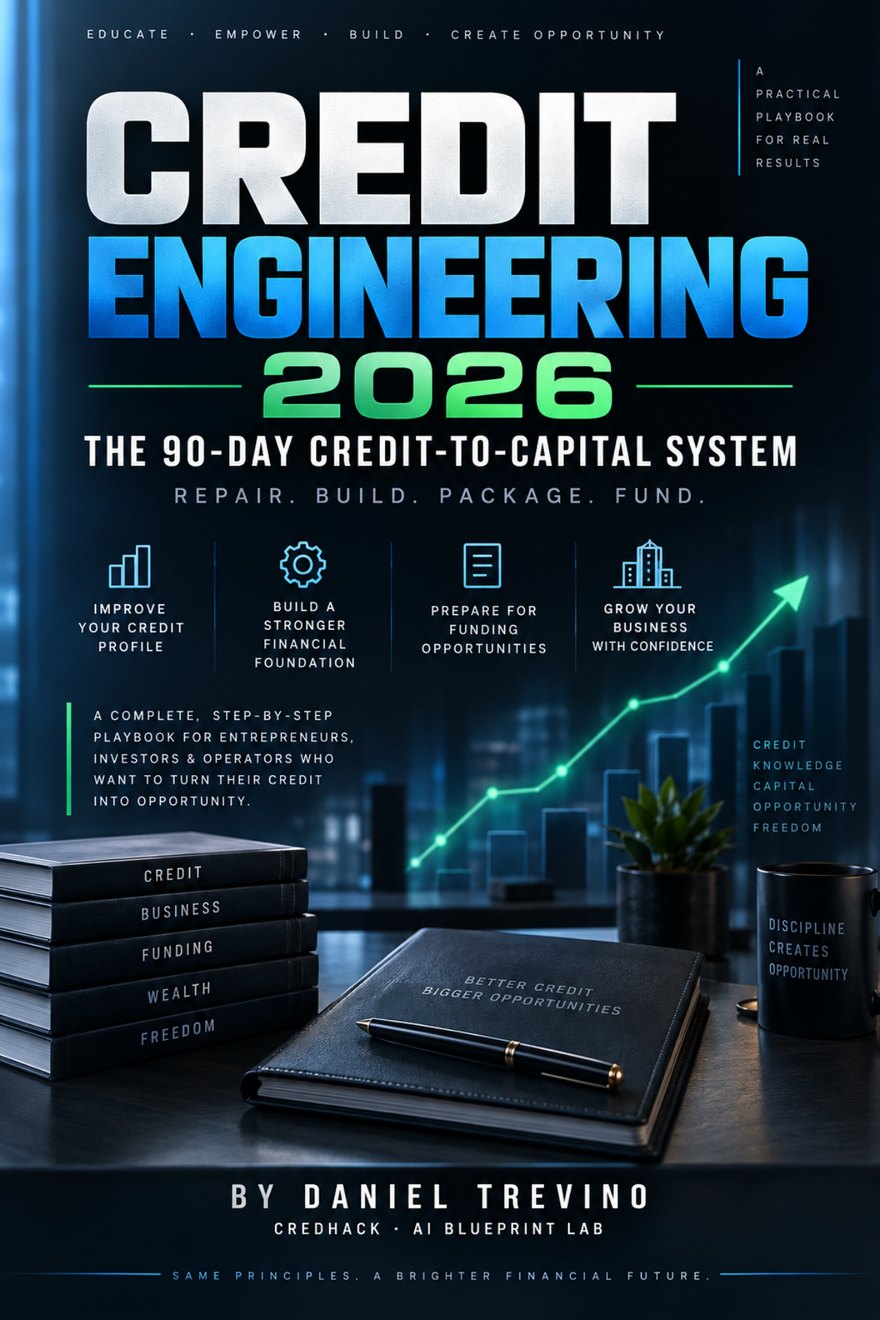
Cover of Credit Engineering 2026 — The 90-Day Credit-to-Capital System by Daniel Trevino: bold white and blue lettering over a dark navy desk scene with a rising green growth line, stacked books labeled Credit, Business, Funding, Wealth, Freedom, and a notebook reading Better Credit, Bigger Opportunities.
01

Credit repair isn't about deleting negatives

That's the premise almost every program sells, and it's why most people stall. Lenders aren't scanning for a clean sheet — they're reading behavior, consistency, and risk patterns across the whole profile. Chapter 1 takes that assumption apart first, because everything downstream depends on getting it right.

Ch. 1 — The Truth About Credit
02

Disputing everything stopped working years ago

Blanket disputes and downloaded templates worked when humans read them. Bureaus now run automated filtering, and a shotgun dispute gets flagged and dismissed. The book covers when to dispute, when not to, and how to do it so it survives the filter — including why disputing an accurate item can set you backward.

Ch. 8 — Strategic Credit Repair
03

Utilization is the fastest lever and almost nobody works it right

Paying your balance isn't the same as reporting a low balance. The difference is which date you pay on. Chapter 4 covers the 1–10% rule, why per-card utilization matters separately from total, and the statement-date timing most people never learn.

Ch. 4 — Utilization: The Fastest Lever
04

The order you pay debts down changes the outcome

Avalanche and snowball are budgeting methods. Neither was designed to move a credit profile. The rapid paydown sequence orders the same dollars differently — and the chapter explains exactly why that order beats both.

Ch. 6 — The Rapid Paydown Sequence
05

There are three passes through your report. You've only done one.

Most people scan for errors and stop. A lender reads in layers: errors first, then the score levers, then the lender-readiness flags that decide approvals before a score is ever discussed. Chapter 3 walks all three, in order.

Ch. 3 — Reading Your Report Like a Lender
Included — Chapter 9

The letter system, written out word for word

You don't draft these from scratch. The book includes the full correspondence set, with guidance on which one fits which situation:

06

A score is a number. A profile is what gets funded.

Two people with identical scores get opposite answers from the same lender, because the lender is reading structure — account mix, age, depth, and how the file is positioned. Chapter 7 lays out what the lender's ideal profile looks like, including where authorized-user accounts help and where they quietly hurt.

Ch. 7 — Building a Lender-Approved Profile
07

Business credit is a 12-step sequence, not a vibe

Most business owners fund growth out of pocket or on personal cards because nobody showed them the order of operations. Chapter 12 is the 12-step build sequence from zero to fundable. Chapter 11 is the 7-point readiness check to run before you apply for anything.

Ch. 11–12 — Readiness & Business Credit
08

There's a 4-prompt AI engine for packaging an LLC

Chapter 13 is the part that doesn't exist in other credit books. Four prompts that take an entity and assemble the funding package — the profile, the positioning, the documentation a lender expects to see. Built by someone who runs AI systems for a living, not bolted on as a trend.

Ch. 13 — The 4-Prompt Funding Engine
09

A pharmacist wrote this, and it reads like it

Pharmacy is mechanism, protocol, timing, and contraindications — what to do, in what order, and what quietly ruins the result. That's the same discipline applied here. Every chapter is marked: principle, playbook, script, worksheet, warning.

It's a system explained by someone still building his own — not a finish-line story sold backwards.

Daniel Trevino, Pharm.D.
Table of contents

All 17 chapters, in the order you run them

Five parts, built to execute in sequence — or drop into any chapter for one specific tactic.

Part IThe Foundationhow lenders read risk
  1. 01The Truth About Credit
  2. 02How Credit Actually Works — the five FICO factors and where the leverage is
  3. 03Reading Your Report Like a Lender
Part IIThe Fast Score Boost0–60 day moves
  1. 04Utilization: The Fastest Lever
  2. 05Payment Strategy
  3. 06The Rapid Paydown Sequence
Part IIIProfile Engineering90+ day positioning
  1. 07Building a Lender-Approved Profile
  2. 08Strategic Credit Repair
  3. 09The Credit Letter System
  4. 10Rapid Inquiry Removal
Part IVFrom Credit to Capitalprofile → approvals
  1. 11Funding Readiness Checklist
  2. 12Business Credit Blueprint
  3. 13The 4-Prompt Funding Engine
  4. 14High-Velocity Capital Stacking
Part VExecutionthe 90-day plan
  1. 15Your 90-Day Action Plan
  2. 16Mistakes That Kill Approvals
  3. 17FAQ
Fit check

Who this is for — and who should skip it

I'd rather you not buy it than buy the wrong thing.

Buy it if

  • You've tried credit repair and the needle barely moved
  • You run a business and fund growth out of pocket or on personal cards
  • You want to understand the mechanism, not just follow steps
  • You'll actually run a 90-day plan instead of reading and shelving it
  • You want the scripts and worksheets, not motivation

Skip it if

  • You want someone to do it for you — this is a playbook, not a service
  • You're looking for a way to remove accurate negative information
  • You want a guaranteed number by a guaranteed date
  • You won't open a worksheet
The offer

Credit Engineering 2026

The 90-Day Credit-to-Capital System. One PDF, downloads the moment you pay, yours to re-run whenever you need it.

  • 17 chapters across 5 parts, built to execute in order
  • The 90-day action plan — what to do in weeks 1 through 12
  • The full letter system — validation, goodwill, dispute, plus the phone playbook
  • Worksheets for applying each chapter to your own file
  • The 4-prompt funding engine for packaging an LLC
  • Mistakes That Kill Approvals — the chapter most people need first
$27 one time · instant download · no subscription
Get the guide $27

Who's writing this

Daniel Trevino, Pharm.D. — pharmacist turned full-time entrepreneur, based in Laredo, Texas.

I spent years trained to think in mechanism and protocol: what acts on what, in what order, at what dose, and what quietly ruins the outcome. When I turned that lens on credit, what struck me was how much advice skips the mechanism entirely and sells the tactic.

So I wrote the version I wanted — one that explains why each move works before telling you to make it. I'm building my own thing in real time, not reporting from the finish line. What I can tell you is that the system in here is the one I actually use, and I've written down all of it.

Credit Engineering 202617 chapters · instant PDF
Get it $27